
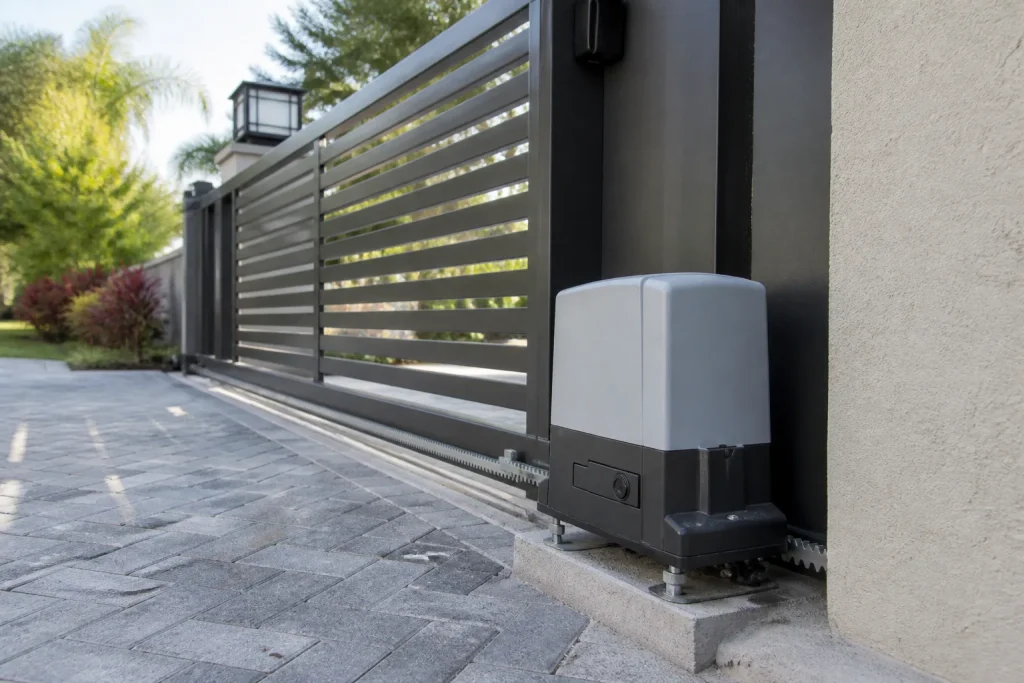
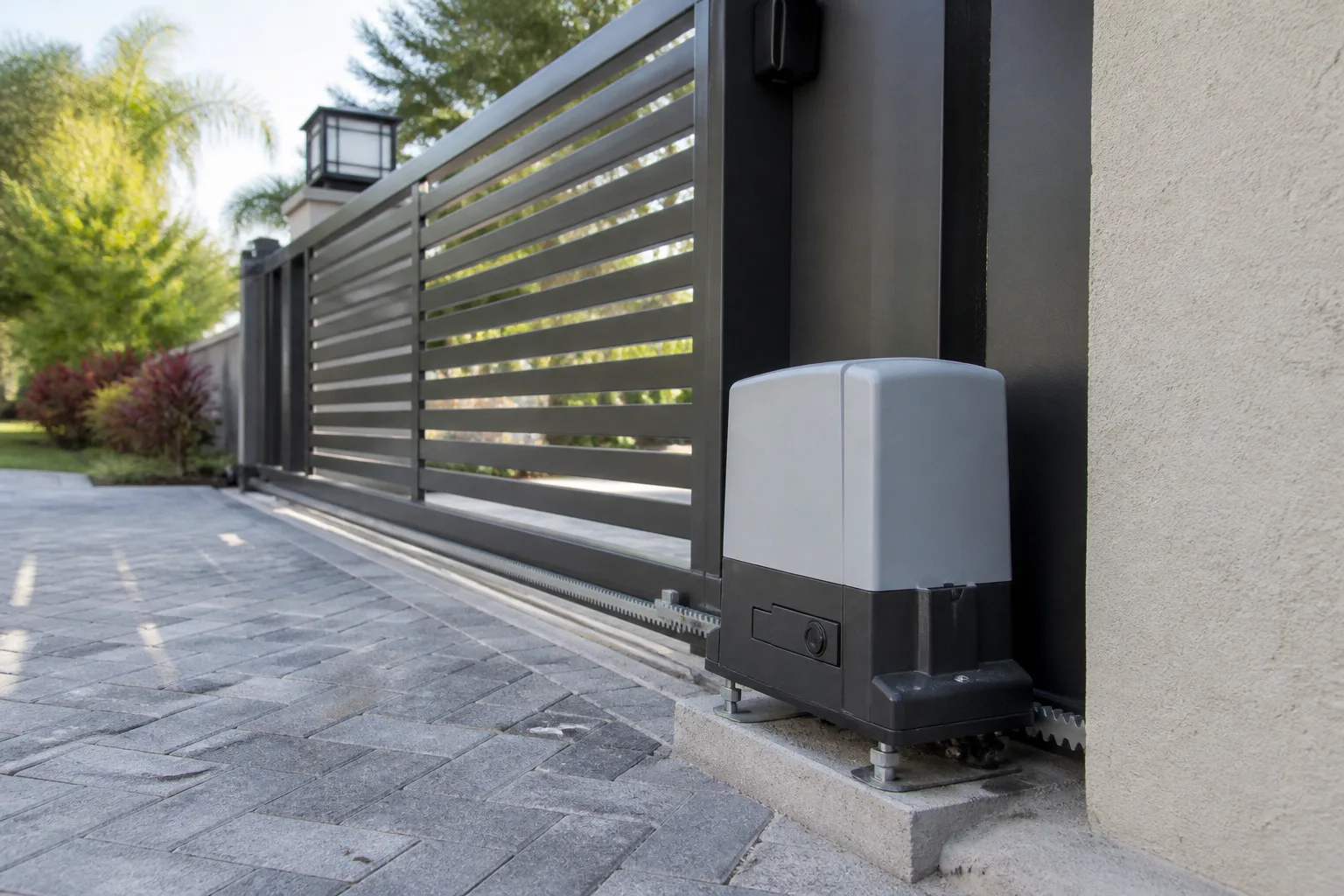
FAAC Gate Repair in Tampa: A Homeowner’s Guide
FAAC gate repair in Tampa usually costs between $275 and $600 for common hydraulic and control board issues, with most jobs completed in a single visit. The most frequent problem we see is a gate that has lost power due to a failed capacitor or control board component, not a broken motor. If your FAAC operator is acting up, don’t assume the worst, and don’t let a generalist talk you into replacing the whole system. Call (866) 976-0095 for a straight answer before you spend a dime.
Most gate companies in Tampa know LiftMaster. Maybe BFT. But FAAC? That’s a different animal entirely. We’ve lost count of how many times we’ve rolled up to a FAAC gate after another contractor “fixed” it two weeks prior. The gate worked for three days, then quit again. Turns out the previous tech swapped in a generic capacitor or bypassed a sensor instead of diagnosing the actual fault. With FAAC systems, that approach costs you money and leaves your gate no more reliable than before.
Why FAAC Operators Fail Differently Than Other Brands
Here’s the thing most homeowners don’t know: FAAC residential and light commercial operators are hydraulic, not gear-driven. LiftMaster and Viking systems rely on a motor turning a gear train or belt. FAAC uses a pump to push hydraulic fluid through a piston, which moves the gate. That design is built for relentless duty cycles and heavy gates. It’s also the reason FAAC gates fail in ways that confuse a technician who only knows gear-driven systems.
When a gear-driven operator wears out, you hear grinding. When a FAAC operator loses fluid or develops a seal leak, the symptom is different: the gate moves slower than usual, or it hesitates at the start of travel, or it shudders partway through the arc. Sometimes it refuses to move at all, but you’ll hear the pump running. That noise is the pump pressing against fluid that isn’t doing its job anymore. A tech who doesn’t know FAAC hydraulics will hear that pump and tell you the motor is bad. It usually isn’t.
We pulled a FAAC 412 out of a gate over in Palma Ceia a few years back where the homeowner had been quoted $2,100 for a full operator replacement. The actual problem was a $14 O-ring on the hydraulic cylinder. Forty-five minutes of labor and the gate ran like new. That’s not a miracle fix. That’s just knowing what to look for. But in Tampa, the heat adds another layer of complexity, which we’ll get to next.
How Tampa Heat Changes FAAC Hydraulic Behavior
Tampa’s summer temperatures regularly push into the mid-90s, and gate operators in direct sun can reach 140 degrees or more. Hydraulic fluid thins as it heats up. For a FAAC system, that means the pump has to work harder to build the same pressure, especially on a heavy gate. If your gate runs fine in the morning but gets sluggish by 2 p.m., that’s a classic sign of heat-thinned fluid or a pump that’s already marginal.
What does that sound like before a full failure? A high-pitched whine from the operator, or a groaning sound during the gate’s mid-travel. Some Tampa homeowners describe it as “the gate sounds tired.” It is tired. The pump is losing volumetric efficiency, and the fluid isn’t maintaining its pressure curve in the heat. Left unchecked, the pump burns out, and then you’re looking at a real replacement cost.
We recommend checking the fluid level and condition at least once a year in Tampa. Fluid that looks dark, cloudy, or has a burnt smell is overdue for a change. FAAC specifies particular hydraulic fluid types, and using the wrong fluid is a common mistake we find on systems serviced by non-specialist contractors. The wrong fluid degrades faster in Florida heat and shortens seal life.
FAAC Error Codes: What They Mean for a Tampa Homeowner
FAAC control boards communicate through a small display or a blinking LED sequence. If your gate stops responding and you see a code, knowing what it means can save you a service call or at least prepare you for the conversation. Here are the three we encounter most often in Tampa:
- E1: Motor or pump overload. The board is sensing excessive current draw. In Tampa, this often points to a hydraulic problem: thick or contaminated fluid, a blocked bypass valve, or a pump that’s binding. It can also mean the gate itself is physically obstructed or binding on its hinges, causing the operator to work harder.
- E2: Limit switch or encoder fault. The operator can’t tell where the gate is. This is frequently a wiring issue, a failed limit switch, or a board that’s lost its programming after a power surge. Tampa’s afternoon thunderstorms bring frequent surges, and FAAC boards are not forgiving about them.
- E5: Safety edge or photocell fault. The board thinks there’s an obstruction in the gate’s path. Often the safety edge has a damaged wire or the photocells are misaligned. Sometimes it’s as simple as the Tampa sun hitting a photocell at the wrong angle and blinding it.
Clearing a code by resetting the breaker is a temporary fix. The underlying condition that triggered the fault is still there, and with E1 specifically, running the gate in a compromised state can finish off the pump. If you see the same code come back within a day or two, it’s time to have the system looked at properly. And not by someone who’s going to guess.
The Parts Problem: Why FAAC Boards Need FAAC Parts
We see this all the time. A homeowner or a generalist contractor orders a “universal” control board or a generic capacitor from an online marketplace because it’s $40 cheaper. Then the gate behaves erratically, or the board fails again in three months.
FAAC boards are engineered to communicate with FAAC-specific components. The voltage tolerances, the logic signals, the feedback loops: everything is matched. Swap in a generic board and you get voltage mismatches, false error codes, and ultimately a fried board. Worse, installing a non-approved board often voids any remaining warranty coverage on the operator itself.
We keep genuine FAAC replacement components in stock for the most common Tampa service calls. That means we arrive with the right board, the right capacitor, the right limit switch, and the right fluid. There’s no week-long wait while we order parts. For gate owners in Tampa, that means less time with a non-functional gate and less exposure at the property line.
When to call a pro: if your FAAC gate is throwing error codes, moving sluggishly, or making a whining or groaning noise, don’t keep resetting the breaker hoping it sorts itself out. Hydraulic problems compound. A $150 fluid and seal service today beats a $900 pump replacement next month. Call (866) 976-0095 and we’ll diagnose it properly the first time. Our work is gate repair in Tampa, end to end.
Common FAAC Installation Mistakes in Tampa
Not every FAAC problem is a wear-and-tear failure. A surprising number of FAAC failures in Tampa are installation errors that took months or years to surface. When a non-specialist contractor installs a FAAC operator, several things go wrong with regularity:
- Wrong mounting plate placement. FAAC operators have specific geometry requirements for the mounting point relative to the gate hinge. A plate mounted an inch too high or too low creates a lever-arm mismatch. The gate opens, but the hydraulic piston is fighting the geometry on every cycle. Premature seal failure follows.
- Missing or undersized limit stops. FAAC hydraulic operators rely on physical limit stops at full open and full close. If the installer doesn’t set them correctly, or uses flimsy stops, the operator’s internal bypass valve is doing the stopping. That builds heat and pressure in the hydraulic circuit, which shortens the life of every seal and the pump itself.
- Incorrect fluid fill at installation. We’ve found systems filled with transmission fluid, power steering fluid, and once, gear oil. A FAAC operator needs the fluid FAAC specifies, filled to the correct level. Wrong fluid doesn’t just lubricate poorly; it attacks the seals.
- No surge protection. Tampa is ground zero for afternoon lightning. FAAC boards are sensitive to voltage spikes. Installing an operator without a surge suppressor at the breaker panel is asking for a dead board during storm season.
If you’re buying a home in Tampa with an existing FAAC gate, and you don’t know who installed it, have it inspected. A quick once-over by someone who knows FAAC systems can reveal if the original install was sound or if there’s a time bomb waiting at the property line. For homeowners considering a new gate system, gate installation in Tampa done right starts with correct operator sizing and mounting geometry.
Repair vs. Replace: The FAAC Threshold in Tampa
FAAC operators are among the most durable on the market. A well-maintained FAAC 400 series or 391 can run reliably for 15 to 20 years in Tampa’s climate, provided the fluid’s been changed periodically and the gate itself hasn’t sagged or bent. But even the best operator reaches a point where throwing money at repairs no longer makes sense.
Our rule of thumb works like this:
- Under 8 years old: Repair almost always wins. The hydraulic components have life left, the board is still supported, and a repair cost under $500 makes financial sense compared to $1,800 to $3,500 for a new operator installed.
- 8 to 14 years old: This is the judgment zone. If the pump is solid and the gate is square, a $300 to $600 repair for a seal, limit switch, or board component is reasonable. But if two or more major systems are failing simultaneously, like the pump and the board, replacement starts looking smarter.
- Over 15 years old: At this age, parts availability narrows, and the failure cascade often accelerates. A $700 repair on a 16-year-old operator, followed by another $400 repair eight months later, means you’ve spent $1,100 on a system that still isn’t reliable. That’s money better applied to a new FAAC unit with a fresh warranty.
The honest answer is that we repair first, because repair is usually the right call. But we’ll tell you clearly when it isn’t. Replacement is only our recommendation when the numbers show that repairing is throwing good money after bad. That’s the benefit of a gate specialist doing the assessment: the recommendation is based on the condition of your system, not on what we’d prefer to sell you.
Related services in Tampa: if your FAAC operator is beyond saving, or if you’re adding a new gate to a property, our gate installation in Tampa service covers full system design and installation. For motorized systems with control board or wiring issues, our electric gate repair in Tampa team handles the full electrical side, from safety loops to intercoms and keypads.
DIY vs. Calling a Specialist for Your FAAC Gate
This is the section where we tell you what you can safely do yourself, and what you should not touch. Hydraulic systems are powerful. A bypassing pump can spray fluid at high pressure. A gate under tension from a broken spring or a shifted mounting plate can move unexpectedly. The work requires respect.
What’s reasonable to check yourself:
- Visual inspection of the fluid reservoir: look for leaks or fluid sprayed inside the operator housing.
- Listening: identify the whining, groaning, or shuddering sounds described above and communicate them clearly to a tech.
- Checking the gate itself: open and close it in manual mode (release the operator per the FAAC manual) and see if the gate moves freely. A binding hinge or sagging gate is a mechanical problem that will eventually kill the operator.
What you should not attempt without proper training:
- Opening the hydraulic circuit or changing fluid. The system is under pressure even when the unit is off.
- Removing or replacing the pump, cylinder, or internal seals. Specialized tools and FAAC-specific procedures are required.
- Using a mechanic’s creeper and a prayer to diagnose a control board. Stay out of the panel. Capacitors store charge even with the breaker off.
If any of this sounds like your situation, or if you’d just rather not spend a Saturday fighting with a gate that won’t cooperate, call us. We work on FAAC systems specifically. We also service Ghost Controls, DoorKing, and Elite systems, so if your gate isn’t FAAC, we still know what’s wrong and how to fix it. Your gate is back to secure, working order, and that’s the whole point. If you’re browsing for a helper, our Tampa Gate Company home page lays out the full picture.
The Bottom Line
FAAC operators are built to a higher standard than most residential gate motors. They’re hydraulic, they’re durable, and they reward correct diagnosis and genuine parts. They punish guesswork. In Tampa, the heat and humidity create specific failure patterns: thinning fluid, struggling pumps, seal degradation, and board failures from lightning. If your FAAC gate is slow, noisy, or throwing error codes, the right move is to get it looked at by someone who knows these systems inside and out.
Our recommendation: don’t let a generalist talk you into replacing a FAAC operator that needs a $300 repair. And don’t reset the breaker a fourth time hoping the problem disappears. If you’re in Tampa and need help with a FAAC gate, Tampa Gate Company offers free estimates and straight answers. Call (866) 976-0095 and tell us what your gate is doing. We’ll tell you what it needs.
Frequently Asked Questions
FAAC gate repair in Tampa typically ranges from $275 to $600 for common issues like seal leaks, limit switch replacement, capacitor failures, and control board diagnostics. Major repairs, like a pump replacement, can run higher. The price is quoted and agreed before any work starts, so there are no surprises on the invoice. Call (866) 976-0095 for an exact quote on your system; estimates are free.
The most common FAAC gate problem we see in Tampa is a gate that has stopped moving due to a failed capacitor or a control board fault, not a broken motor. Close behind that is sluggish operation caused by heat-thinned hydraulic fluid or a worn pump. Tampa’s summer heat accelerates both issues. If your gate runs fine in the morning and poorly in the afternoon, the fluid and pump need attention before the pump fails completely.
Most FAAC gate repairs in Tampa are completed in a single visit. We carry genuine FAAC replacement parts for the most common failure points, including control boards, capacitors, limit switches, and hydraulic seals. If your system needs a part we don’t have on the truck, we’ll get it ordered and scheduled quickly. Call (866) 976-0095 and describe what your gate is doing; we’ll let you know what the visit will involve.
A properly maintained FAAC operator in Tampa typically lasts 15 to 20 years. The keys are annual fluid checks, replacing fluid that’s darkened or burnt-smelling, keeping the gate itself square and lubricated, and protecting the control board with a surge suppressor. We’ve seen FAAC units in Tampa fail at under 10 years when installed incorrectly or serviced with the wrong fluid, and we’ve seen units past 20 years that were simply well cared for.
Written by the team at Tampa Gate Company, serving Tampa since 2013.
Need Gate Repair Help?
Call Tampa Gate Company — licensed & insured, here with fast after-hours help in Tampa.
(866) 976-0095